The Fit Factor: How Understanding Your Biomechanics Transforms Equipment Selection
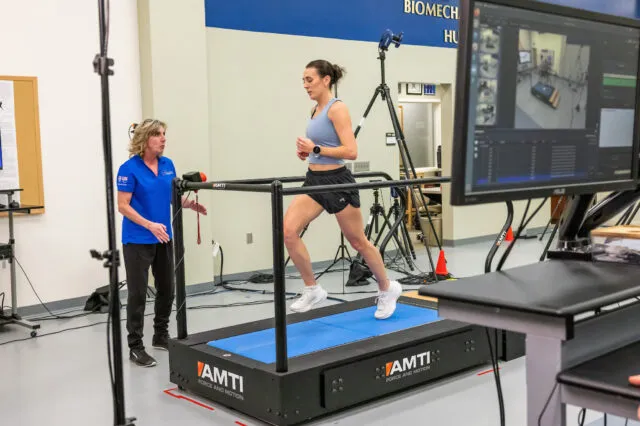
Photo: athlete biomechanics gait analysis sports equipment fitting laboratory, via ufhealth.org
Walk into any sporting goods store in the United States and you will find walls of footwear, racks of braces, and shelves of training implements—all marketed with broadly universal claims. "Maximum support." "Optimal cushioning." "Engineered for performance." What these labels rarely acknowledge is that the human body does not conform to a single template, and equipment that performs exceptionally for one athlete may actively impede another.
Biomechanics—the study of how mechanical principles apply to biological movement—offers serious athletes a framework for moving past generic recommendations and making equipment decisions grounded in their individual physiology. At SportsProMax, we believe that understanding your movement profile is as fundamental to performance as your training program itself.
Why One-Size-Fits-All Fails Serious Athletes
The sporting goods industry has historically designed products around a composite average—a hypothetical athlete whose proportions, movement patterns, and structural characteristics represent the statistical mean of a tested population. For athletes whose bodies and movement profiles fall near that average, the system works reasonably well.
For everyone else, it introduces a persistent mismatch between how equipment is designed to function and how it actually performs on their body. This mismatch manifests in several ways: reduced power transfer efficiency, compensatory movement patterns that strain secondary muscle groups, and—most consequentially—elevated injury risk.
Research from the American Journal of Sports Medicine has documented that up to 60 percent of overuse injuries in recreational and competitive athletes are attributable at least in part to equipment-related factors, including improper footwear, poorly fitted protective gear, and implements that do not match the user's structural characteristics.
Understanding Your Movement Profile: Where to Begin
A meaningful biomechanical assessment does not require a sports science laboratory, though access to one is certainly valuable. The process begins with three foundational questions.
What is your dominant movement pattern in your sport? A basketball player's movement vocabulary is dominated by lateral cuts, vertical jumps, and rapid deceleration. A distance runner's is characterized by repetitive sagittal-plane locomotion. A baseball pitcher's involves extreme rotational forces concentrated through the shoulder and elbow. Each pattern places distinct demands on joints, connective tissue, and footwear contact surfaces.
What structural characteristics define your lower kinetic chain? Foot arch height, tibial rotation, hip width, and Q-angle (the angle between the quadriceps and patellar tendon) all influence how forces travel through the body during athletic movement. Athletes with high arches tend toward supination and may require more lateral cushioning. Those with flat arches frequently overpronate and benefit from motion-control features in footwear. Hip width affects knee tracking, which in turn influences ideal cleat placement and pedal positioning.
Where do you experience recurring tightness, discomfort, or previous injury? Injury history is a biomechanical map. Chronic IT band issues point toward hip abductor weakness and potential overpronation. Recurring shin splints suggest ground reaction force absorption problems. Shoulder impingement in overhead athletes often reflects scapular dyskinesis that equipment selection—particularly in racket sports—can either aggravate or mitigate.
Gait Analysis: The Most Accessible Biomechanical Tool
For athletes whose sport involves running or sustained locomotion, gait analysis represents the single most accessible entry point into biomechanical assessment. Many specialty running stores across the US offer complimentary video gait analysis, and a growing number of sports medicine clinics provide comprehensive force-plate assessments for athletes seeking more detailed data.
At its most basic level, gait analysis reveals your foot strike pattern (heel, midfoot, or forefoot), cadence, and degree of pronation or supination. These variables directly inform footwear selection, including stack height, heel-to-toe drop, and the type and placement of stability features.
A case worth examining: a competitive age-group triathlete in her mid-30s had been managing chronic plantar fasciitis for nearly two seasons while training in a maximally cushioned neutral shoe—a category often marketed as the gold standard for long-distance athletes. Gait analysis revealed significant overpronation that the neutral shoe's construction was not designed to address. Transitioning to a stability shoe with structured medial support, combined with custom orthotic insoles, resolved her symptoms within eight weeks without any change to her training volume.
Sport-Specific Movement Inefficiencies and Equipment Solutions
Certain biomechanical inefficiencies appear with disproportionate frequency within specific athletic populations. Recognizing these patterns allows athletes to proactively address equipment fit before problems develop.
Team Sport Athletes (Basketball, Soccer, Football): Lateral instability is the predominant concern. Athletes with naturally loose ankle ligaments or a history of ankle sprains benefit significantly from footwear with structured lateral walls and ankle collars. High-cut designs offer mechanical support; low-cut designs prioritize agility. The correct choice depends on the athlete's position and injury history, not simply personal preference.
Cyclists: Saddle height, cleat alignment, and handlebar reach collectively determine whether a cyclist generates power efficiently or dissipates it through misaligned joints. Cleat placement that does not account for natural foot angle (called float) creates rotational stress at the knee that accumulates across thousands of pedal strokes. A professional bike fit—which SportsProMax strongly recommends for any cyclist logging significant mileage—can identify and correct these alignment issues with precision.
Overhead Athletes (Baseball, Tennis, Volleyball): Racket weight, grip circumference, and string tension interact with shoulder mechanics in ways that meaningfully affect both performance and injury risk. A grip that is too small promotes excessive wrist pronation; one that is too large limits wrist snap and increases forearm fatigue. The correct grip size is typically determined by measuring from the middle crease of the palm to the tip of the ring finger.
Strength and Power Athletes: Bar path, stance width, and shoe heel elevation are the primary equipment variables for lifters. Olympic weightlifting shoes with elevated heels allow greater ankle dorsiflexion, which facilitates deeper squat positions without compromising lumbar alignment. Athletes with limited ankle mobility often find that this single equipment change produces immediate improvements in squat depth and back position.
A Framework for Testing Equipment Fit
Equipment selection should be treated as a hypothesis, not a permanent decision. The following framework provides a structured approach to evaluating whether a piece of gear genuinely matches your biomechanical profile.
-
Establish a baseline. Before introducing new equipment, document your current performance markers and any discomfort patterns. Video your movement from multiple angles if possible.
-
Introduce one variable at a time. Testing multiple new pieces of equipment simultaneously makes it impossible to isolate which change is producing which effect.
-
Allow an adequate adaptation period. Minor discomfort during the first few sessions with new footwear or an adjusted implement does not necessarily indicate poor fit. Allow two to three weeks before drawing conclusions, unless pain is acute.
-
Reassess against your baseline. Has movement quality improved? Have compensatory patterns diminished? Is discomfort in previously problematic areas reduced?
-
Consult a specialist when data is ambiguous. Physical therapists, certified athletic trainers, and sports biomechanists are trained to identify movement inefficiencies that are not visible to the untrained eye. For serious athletes, this investment consistently yields measurable returns.
Equipment as a Biomechanical Partner
At SportsProMax, our product curation philosophy is built on the recognition that elite equipment must do more than perform well in aggregate—it must perform well for you specifically. Our staff is trained to ask the questions that surface individual biomechanical needs, and our inventory spans the full spectrum of structural support, cushioning profiles, and fit geometries that serious athletes require.
Your training program builds the engine. The right equipment ensures that every ounce of that effort is translated into performance rather than absorbed by compensation, inefficiency, or injury. That is not a minor distinction. For competitive athletes, it is often the difference between a season that builds toward your goals and one that falls short of them.